Quick answer: Bed bugs on a mattress show up as tiny dark spots along the seams, pale eggs and shed skins, rusty smears and the flat brown bugs themselves. You usually don't need to throw the mattress out. Vacuum and steam the seams, zip it into a bed bug encasement and leave it on for at least a year.1,2,3
Key Takeaways
- Most bed bugs are in the bed, not just the mattress. When researchers tallied the bed bugs found in infested apartments, 70% to 85% were on the bed, and in one study the box spring held more than the mattress.4,5
- Check the seams first. Look along the piping, seams, tags and tufts for dark spots, eggs, shed skins and live bugs.1,2
- Bed bugs can't burrow into a mattress. They hide in seams, folds and existing openings, not inside the foam.6
- You can usually keep the mattress. Steam and vacuum the seams, then encase it. A new mattress in an untreated room just gets reinfested.2,7
- Spray only what the label allows. Use a product whose label lists mattresses, only on seams, tufts and edges, never on the sleeping surface.8,3
- Skip Lysol, rubbing alcohol, bleach and bug bombs. None of them reliably kills bed bugs, and alcohol has started house fires.9,10,11,12
Finding bed bugs on your mattress is upsetting, but it's also the most common place to find them, and the problem is very fixable. This guide shows what bed bugs and their signs look like on a mattress, how to check one step by step, what actually kills them there, what you can safely spray, and when (rarely) a mattress should go.
In this guide
- What bed bugs look like on a mattress
- Where they hide on the bed
- How to check a mattress, step by step
- Can bed bugs live inside a mattress?
- How to get rid of bed bugs in a mattress
- What can you spray on a mattress?
- Does Lysol kill bed bugs on a mattress?
- Should you throw out your mattress?
- How to get rid of an infested mattress
- New and used mattresses
- After treatment
- FAQ
What Do Bed Bugs Look Like on a Mattress?
You may see the bugs themselves, but more often you'll see what they leave behind. Look for:
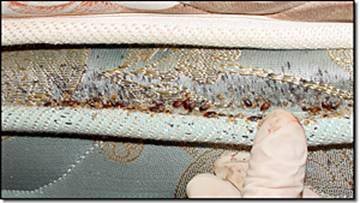
- Dark spots. Bed bug droppings are dark, about the size of a printed period, and usually clustered along seams. They soak into fabric like a marker would.1,2
- Rusty smears. Reddish or rusty stains on sheets or the mattress come from bugs crushed after feeding.1,13
- Eggs. About 1 mm long (pinhead size), pale and sticky, so they're hard to spot on light fabric. A magnifying glass helps.1,2,14
- Shed skins. Pale, empty casts left as young bed bugs grow.2,1
- Live bugs. Adults are flat, brown and about the size of an apple seed. Young ones start out pinhead-sized and pale until they feed.15,16

The wet-tissue test: wipe a dark spot with a damp tissue. If it smears rusty brown, it's likely bed bug droppings. It's a good first clue, not proof.16,17
What proves you have them now? Only live bugs or unhatched eggs confirm an active infestation. Spots, skins and dead bugs can be old.7 If you're not sure what you found, get it identified: at the University of Minnesota, 76% of samples people sent in weren't bed bugs.18 For more photos, see bed bug pictures and signs of bed bugs.
Where Do Bed Bugs Hide on a Mattress and Bed?
- Mattress: piping, seams, tags, tufts, buttons and folds.1,18,14
- Box spring: the upper and lower seams, the underside, under the thin dust cover and in the wooden frame inside.2,17
- Bed frame and headboard: cracks, joints and the slots where the rails attach.2,1
Bed bugs usually stay close to where people sleep. CDC says they're usually found within about 8 feet of the bed.13
| Where the bed bugs were | Kentucky study (13 apartments) | Purdue study (8 apartments) |
|---|---|---|
| Box springs | 35% | 85% (mattresses and box springs together) |
| Mattresses | 22% | |
| Bed frames and headboards | 13% | Not counted separately |
| Sofas, couches and recliners | 23% | 14% |
| Everywhere else | 7% | 1% |
Researchers recorded the live bed bugs found in each spot during inspections.4,5 The box spring is often the bigger hiding place, so check it as carefully as the mattress. See where bed bugs hide for the rest of the room.
How Do You Check a Mattress for Bed Bugs?
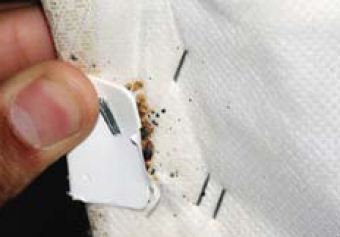
- Get a bright flashlight and a thin card. An old credit card, playing card or putty knife works. A magnifying glass helps with eggs.17,3,14 Any crack a credit card fits into can hide a bed bug.1
- Strip the bed. Check the sheets and pillowcases for spots and smears first.18
- Go along every seam. Run the light and card slowly along the piping, seams, tags and tufts on the top, sides and underside of the mattress.14,1,17
- Check the box spring. Stand it on edge, check both seams, pull back the dust cover on the bottom and look at the wood frame inside.2,17
- Check the frame and headboard. Look in joints and screw holes. Take the bed apart if you can.2,17
- Test any spots with a damp tissue.16
- Widen the search to nearby furniture, including chairs and the couch, if you find signs.1
A thorough check can take a while.2 Visual checks alone catch about 72% of infestations. Adding interceptor cups under the bed legs raises that to 99%.19 You can get a ClimbUp interceptor (we earn a small commission) or see our bed bug traps guide.
Can Bed Bugs Live Inside a Mattress?
Not the way most people imagine. Bed bugs can't chew or burrow into a mattress, foam or pillow.6 They hide in openings that already exist: seams, folds, torn fabric and the coils and wood inside box springs.19,2
No mattress type is immune. Bed bugs can still hide in the seams, folds and covers of memory foam and air mattresses, and in the bed frame.6,2 Bed bugs don't like to climb or stay on smooth plastic, which makes smooth surfaces easier to inspect.10
Found bed bugs on your mattress?
Get a free, no-obligation quote from a local bed bug exterminator.
Call 1-877-673-2704Free quote · No obligation · We may earn a referral fee when you call.
How Do You Get Rid of Bed Bugs in a Mattress?
For most mattresses, the plan is vacuum, steam, encase and monitor. Treat the rest of the room at the same time, since bugs in the frame and furniture will come back to the bed.2,7
1. Vacuum the seams
Scrub the seams with a stiff brush to loosen eggs, then run the crevice tool slowly along every seam, fold and edge.3,2 Seal the bag in plastic and take it to an outdoor trash can right away so captured bugs can't get back out.20,10 Vacuuming misses many eggs, so don't stop there.19,10
2. Steam the seams
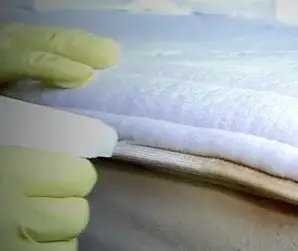
Steam is one of the best tools for a mattress. In a Rutgers study, steamers killed every exposed bed bug on mattress surfaces and in cracks, and more than 89% hidden under a fabric cover.21 Move slowly, about 20 seconds per foot of seam, so the surface reaches about 158°F to 176°F.17,7 Steam only reaches about three-quarters of an inch into fabric and leaves nothing behind to kill bugs later, so use it with the other steps.7,2 A handheld steamer (we earn a small commission) works for seams; test a hidden spot first.19
3. Zip on a bed bug encasement
A zippered bed bug encasement traps any bugs still inside until they die, covers the seams they hide in and gives you a smooth, light surface where new bugs are easy to spot.2,22,10 Encase the box spring too; if you can only cover one, Kentucky entomologists say pick the box spring.2 Leave the encasement on for at least a year.3,23 Get a zippered bed bug mattress encasement (we earn a small commission), and see our mattress encasement guide for what to look for.
An encasement protects the mattress, not you. In a Rutgers lab test, covers kept most bugs off the mattress and box spring but pushed more of them onto the bed frame and floor.24 Put interceptors under the legs too.
4. Heat the bedding
A mattress won't fit in a dryer, but your sheets, pillowcases and blankets will. Dry them on high heat for at least 20 minutes.18,23 Bed bugs die at about 122°F within a minute, but at lower temperatures they need much longer.7 For clothes, see how to kill bed bugs on clothes.
| Method | Works on a mattress? | Notes |
|---|---|---|
| Vacuuming | Partly | Removes many bugs, misses eggs. Seal and toss the bag.2,19 |
| Steam | Yes, on the surface | 100% of exposed bugs in a Rutgers test; reaches about 3/4 inch deep.21,7 |
| Encasement | Yes | Traps bugs inside; keep it on for at least a year.2,3 |
| Labeled bed bug spray or dust | Only on seams and edges | Only if the label lists mattresses.8,25 |
| Lysol, alcohol, bleach | No | Not reliable; alcohol and Lysol are flammable.9,10,26 |
| Bug bombs (foggers) | No | Fog doesn't reach hiding spots.12 |
What Can You Spray on a Mattress for Bed Bugs?
Only a product that is registered for bed bugs and whose label lists mattresses. Using a product on a bed when the label doesn't allow it can poison the people sleeping there.11,27 Many bed bug sprays don't allow mattress use at all, so read the label first.19
When a label does allow it, it typically limits you to the seams, tufts, folds and edges, sprayed until just moist. Let the mattress dry before you remake the bed, and never spray the sheets or the surface you sleep on.8,3 Insecticide dusts labeled for mattresses are puffed on in a light film along the tufts, folds and edges, in tiny amounts.25,2
This matters. From 2006 to 2010, the National Pesticide Information Center logged 129 calls about people who got sick from bed bug pesticides used in their homes, including one death, CDC reported. In one case an infant got sick after being placed on a mattress treated with an undiluted indoor insecticide.27 Most bed bugs also resist common pyrethroid-only sprays.10,2 Our bed bug spray guide covers which products still work.
Will Spraying Lysol on a Mattress Kill Bed Bugs?
No. Lysol Disinfecting Spray is a disinfectant. Its label covers germs, not insects, and it warns that the spray is flammable.9 When Rutgers researchers sprayed bed bugs directly with a disinfectant, every bug survived.10 EPA warns that any product not labeled for bed bugs hasn't been tested against them.28
- Rubbing alcohol killed at most about half the bed bugs it was sprayed on, and it has started house fires. In 2017, a Cincinnati woman's attempt to kill bed bugs with alcohol started a fire that hurt 3 people and forced 10 from their homes.10,29,11,30
- Bleach doesn't get rid of bed bugs and can harm you.26,2
- Bug bombs don't reach the seams and cracks where bed bugs hide, and too many can cause an explosion.12,10
Should You Throw Out Your Mattress If You Have Bed Bugs?
Usually not. Extension entomologists and the pest control industry agree that most infested mattresses can be treated and kept.2,7 Throwing a mattress out is expensive and doesn't solve the problem, because bed bugs also live in the box spring, bed frame and nearby furniture. A new mattress in an untreated room just gets reinfested.7 An encased mattress can stay in use as long as the cover isn't torn.18 In the Purdue apartment study, no mattresses were thrown out, only one heavily infested box spring.5
| Keep it and encase it if… | Consider replacing it if… |
|---|---|
| The fabric is intact | It's torn or damaged so it can't be sealed in an encasement |
| You can encase both mattress and box spring | It's an infested box spring you can't cover with an encasement3 |
| You're treating the whole room | You wanted a new mattress anyway2 |
If you do replace it, wait until the infestation is under control, then encase the new mattress before it goes on the bed.31,18
How Do You Get Rid of a Mattress With Bed Bugs?
- Wrap it in plastic before you move it, ideally in the room where it was, so bugs don't fall off on the way out.32,2
- Make it unusable. Slash the fabric so no one takes it home.32,20,7
- Label it. Write "Bed bugs" on it so no one picks it up.32,20
- Put it out close to pickup time, or take it to the dump.32,14
- Never sell or donate an infested mattress.32,3
New York City rule: every mattress and box spring put out for city trash pickup must be fully sealed in plastic, bed bugs or not. Fines run up to $300.33 Other cities may have their own rules, so check with your local sanitation department.
Can a New or Used Mattress Have Bed Bugs?
Used mattresses are a common way bed bugs get into homes. Never bring home a mattress from the curb, and inspect any secondhand bed closely.2,18,3 Some states regulate used bedding. In New York, a seller must sanitize a used mattress and attach a yellow label reading "used bedding" or "used material."34 NC State suggests avoiding used mattresses unless they carry a tag showing they were sanitized.31
New mattresses can be exposed when old and new bedding travel in the same truck. New York law now bars carrying used bedding with new bedding unless the used items are sanitized or sealed in plastic.34,35 Check a new mattress when it arrives, and encase it if you're worried.18,2
What to Expect After Treating a Mattress
- Bugs trapped in an encasement can live for months. Adults lasted about 43 to 99 days on average without feeding at room temperature in one study, and in a cool room they can survive a year or more. That's why the encasement stays on for a year.36,2,23
- New bites may be old bites. Some people don't show a bite mark for up to 14 days.13 Bites that keep appearing weeks later suggest live bugs remain somewhere.
- Keep checking. EPA suggests checking every few days at first, then at least weekly, for at least a year.20 Interceptors under each bed leg confirm whether bugs are gone and catch new ones early.2
If bites continue, it's time for a professional. See how to get rid of bed bugs and how to find a bed bug exterminator. You can also ask a pest expert online (we may be paid when you use this link), or call 1-877-673-2704 for free quotes from local exterminators (we may be paid when you call).
What the Research Shows
- The bed is the hot spot: in Kentucky apartments, 70% of all bed bugs were on beds, with box springs holding 35% and mattresses 22%.4
- Steam works on the surface: Rutgers found three different steamers killed every exposed bed bug on mattresses.21 Texas A&M found steam killed 84% to 94% of nymphs and adults and every egg on mattress edges.37
- Encasements move bugs: with a vinyl encasement, the share of bed bugs on the bed frame rose from 45% to 69% in a Rutgers lab test.24
- Heat needs time: at 113°F adult bed bugs took about 95 minutes to die, while eggs survived up to about 7 hours; nothing survived above 122°F.38
- Starvation takes months: adult bed bugs lived about 43 to 99 days on average without a meal.36
Bed Bugs on a Mattress: Frequently Asked Questions
Should I throw out my mattress if I have bed bugs?
Usually not. Most mattresses can be treated and sealed in a bed bug encasement. A new mattress in an untreated room just gets reinfested, because bed bugs also live in the frame and nearby furniture.2,7
What can I spray on my mattress for bed bugs?
Only a bed bug product whose label lists mattresses, and only on the seams, tufts, folds and edges. Let it dry, and never spray the sleeping surface or your sheets.8,3
Will spraying Lysol on my mattress kill bed bugs?
No. Lysol is a disinfectant, not a bed bug killer, and it's flammable. A disinfectant sprayed directly on bed bugs in a Rutgers test killed none of them.9,10
What are the first signs of bed bugs on a mattress?
Small dark spots along the seams, rusty smears, tiny pale eggs, shed skins and the bugs themselves.1,2
How do I check my mattress for bed bugs?
Strip the bed and use a flashlight and a thin card to go along every seam, tag and tuft, then check the box spring, under its dust cover and the bed frame.17,2
Can bed bugs live inside a memory foam mattress?
Bed bugs can't burrow into foam. They hide in seams, zippers, covers and the bed frame, so no mattress type is immune.6
Does steam kill bed bugs in a mattress?
Yes, on the surface. Steam killed every exposed bed bug on mattresses in a Rutgers study, but it only reaches about three-quarters of an inch into fabric.21,7
How long do I keep a mattress encasement on?
At least a year. Bed bugs trapped inside can live for months without feeding, longer in a cool room.3,36,2
Can a new mattress have bed bugs?
It's possible if it's carried with used bedding. Inspect a new mattress when it arrives and encase it if you're worried.34,18
How do I get rid of a mattress with bed bugs?
Wrap it in plastic before moving it, slash the fabric and label it "bed bugs" so no one takes it. New York City requires every discarded mattress to be sealed in plastic.32,33
This page is general information, not medical or professional pest control advice. Always follow the label on any pesticide.
References
- U.S. Environmental Protection Agency. How to Find Bed Bugs. U.S. EPA, updated September 8, 2026. www.epa.gov
- Potter MF. Bed Bugs, ENTFACT-636. University of Kentucky Entomology, rev. March 2026. entomology.mgcafe.uky.edu
- New York City Department of Health and Mental Hygiene. Stop Bed Bugs Safely. NYC DOHMH, rev. December 2008. www.nyc.gov
- Potter MF, Haynes KF, Romero A, Wickemeyer W. Battling bed bugs in apartments. Pest Control Technology, August 2006. www.pctonline.com
- Wang C, Abou El-Nour MM, Bennett GW. Case study: Controlling bed bugs in apartments. Pest Control Technology, November 2007 (Purdue; Rutgers-hosted copy). entomology.rutgers.edu
- Bohart Museum of Entomology, UC Davis. Information No. 064: Bedbugs. UC Davis, n.d. bohart.ucdavis.edu
- National Pest Management Association. Bed Bug Best Management Practices: A Guide for Pest Management Professionals (rev. July 2023, v2). NPMA, 2023. www.npmapestworld.org
- McLaughlin Gormley King Co. Multicide Spray 29512 EPA-accepted label, EPA Reg. No. 1021-2570. U.S. EPA, 2026. www3.epa.gov
- Reckitt Benckiser. Lysol Disinfecting Spray EPA-accepted label, EPA Reg. No. 777-99. U.S. EPA, 2014. www3.epa.gov
- Wang C, Cooper R. Cost-Effective and Money-Wasting Bed Bug Control Methods, FS1251. Rutgers NJAES Cooperative Extension, March 2019. njaes.rutgers.edu
- U.S. Environmental Protection Agency. Stay Legal and Safe When Treating Bed Bugs. U.S. EPA, updated August 31, 2026. www.epa.gov
- U.S. Environmental Protection Agency. Should I Use a Fogger? U.S. EPA, updated September 8, 2026. www.epa.gov
- Centers for Disease Control and Prevention. About Bed Bugs. CDC, reviewed April 26, 2024. www.cdc.gov
- Sutherland AM, Choe DH, Lewis VR. Pest Notes: Bed Bugs, Publication 7454. UC Statewide IPM Program, updated May 2013. ipm.ucanr.edu
- U.S. Environmental Protection Agency. Bed Bugs: Appearance and Life Cycle. U.S. EPA, updated January 6, 2026. www.epa.gov
- New York State IPM Program, Cornell University. Identifying Bed Bugs. Cornell CALS, n.d. cals.cornell.edu
- Georgia Department of Public Health, Environmental Health. Homeowners' Do It Yourself (DIY) Bed Bug Control Guidance (adapted from Michigan State University Extension and Michigan DCH). Georgia DPH, n.d. dph.georgia.gov
- Hahn J, Kells S. Bed bugs. University of Minnesota Extension, reviewed 2023. extension.umn.edu
- Quesada C, Gripp S. Biology, Habitat, and Management of Bed Bugs. Penn State Extension, updated June 26, 2025. extension.psu.edu
- U.S. Environmental Protection Agency. Do-it-yourself Bed Bug Control. U.S. EPA, updated August 10, 2026. www.epa.gov
- Wang D, Wang C, Wang G, Zha C, Eiden AL, Cooper R. Efficacy of three different steamers for control of bed bugs (Cimex lectularius L.). Pest Management Science 74(9):2030–2037, 2018 (abstract record, PestInfo Wiki). wiki.pestinfo.org
- U.S. Environmental Protection Agency. Protecting Your Home from Bed Bugs. U.S. EPA, updated July 6, 2026. www.epa.gov
- Pennsylvania IPM Program (Penn State) and Philadelphia School & Community IPM Partnership. Got Bed Bugs? (hosted by Texas A&M Extension Entomology), n.d. extensionentomology.tamu.edu
- Rutgers Urban IPM Laboratory (Sked S et al.). Effect of encasement presence and type of material used on bed bug distribution. Pest Control Technology, c. December 2022. www.pctonline.com
- Rockwell Labs. SiliCide / CimeXa Insecticide Dust EPA-accepted label, EPA Reg. No. 73079-12, 92.1% amorphous silica. U.S. EPA, 2016. www3.epa.gov
- Linn S, et al. I found some bed bugs in my house. Can I use bleach to kill bed bugs? UF/IFAS Entomology and Nematology blog, May 25, 2016. blogs.ifas.ufl.edu
- CDC and ATSDR. Health Concerns about Misuse of Pesticides for Bed Bug Control, HAN 00336. CDC Health Alert Network, November 27, 2012. archive.cdc.gov
- U.S. Environmental Protection Agency. Consumer Alert: EPA Advises Care When Selecting Pesticides for Bedbug Control (news release). U.S. EPA, August 10, 2010. www.epa.gov
- Texas A&M AgriLife Extension. Rubbing alcohol not a good solution for bed bugs. Insects in the City blog, January 2, 2014. citybugs.tamu.edu
- Associated Press. Woman burns down Cincinnati, Ohio, home trying to kill bedbugs. CBS News, December 9, 2017. www.cbsnews.com
- NC State Extension, Department of Entomology and Plant Pathology. Bedbugs: Biology and Control. NC State Extension Publications, June 30, 2018. content.ces.ncsu.edu
- New York City Department of Health and Mental Hygiene. Bed bugs: disposal of mattresses, box springs and furniture (fact sheet). NYC DOHMH, n.d. nyc.gov
- New York City Department of Sanitation. Furniture, Mattresses, and Rugs. DSNY, accessed November 2, 2026. www.nyc.gov
- New York Department of State. Articles: Bedding (General Business Law Article 25 and 19 NYCRR Part 199). NY DOS, accessed November 2, 2026. dos.ny.gov
- Office of Assemblyman Jeffrey Dinowitz. Assemblyman Dinowitz, Senator Peralta Close Loophole to Combat Spread of Bedbugs. New York State Assembly, November 30, 2017. www.assembly.ny.gov
- Polanco AM, Miller DM, Brewster CC. Survivorship during starvation for Cimex lectularius L. Insects 2(2):232–242, 2011. www.mdpi.com
- Puckett RT, McDonald DL, Gold RE. Comparison of multiple steam treatment durations for control of bed bugs (Cimex lectularius L.). Pest Management Science 69:1061–1065, 2013 (Texas A&M). urbanentomology.tamu.edu
- Kells SA, Goblirsch MJ. Temperature and time requirements for controlling bed bugs (Cimex lectularius) under commercial heat treatment conditions. Insects 2(3):412–422, 2011. www.mdpi.com