The Bed Bugs Handbook is committed to providing information on how to recognize a bed bug problem and how to remove these pests from your home or apartment. This page has 28 images and detailed information to help you identify bites, the pests themselves, and how to control and treat an infestation.
If we had one piece of advice, it would be to act fast as an infestation can quickly grow, following the following steps:
1. Confirm you have a problem by finding two or more signs of an infestation (bites, actual insects or signs of insects).
2. Get expert confirmation by an exterminator or testing lab.
3. Control the problem with professional treatment (preferable) , or with a do it yourself kit (smaller or new infestations).
4. Confirm the problem is gone by installing a bed bug trap. If the trap stays empty for 2 weeks, you are good to go.
A summary of everything you need to know can be found on this page.
What you need to know
According to a study conducted by the National Pest Management Association (NPMA) and the University of Kentucky, if you have bedbugs in your home you are not alone. There has been an 81% increase in homeowner or renter calls since the year 2000. The study goes on to state that we are on the threshold of a global pandemic. It also states that bed bugs are harder to treat than cockroaches, ants and termites.
These insects have been found everywhere including hospitals, daycare centers, college dorms, religious institutions, homes, apartments, libraries and even theaters. No location is immune. It doesn't matter how rich or poor you are, if someone carries a pregnant female bed bug into your home, the insect will multiply quickly.
Having bed bugs in your home does not mean that your home is unclean. The bugs can ride into your house on clothing or crawl out of luggage or suitcases carried from an infested hotel room, dorm rooms, countries around the globe that have frequent problems, or cruise ships. You may even bring them into your house on used furniture. Be especially cautious of used mattresses and bed frames. Finally, your house or apartment could already be infested when you move in or if they moved from another apartment into yours.
 There Have Been Bed Bug Reports In Every U.S. State
Source: Bed Bug Registry
Overview
- External parasitic insect
- Great hitchhiker
- Usually active only at night, 2 hours before dawn
- Feeds on warm blooded sources, and prefers humans
- Will also feed on bats, rodents, birds, cats and dogs
- Can live for 10 to 20 months and up to a year without feeding
- Seeks to live near a food source
- Fast moving
- Infestations not linked to cleanliness
- You can find bed bugs anywhere including public transit, apartments, schools, offices, hotels, healthcare facilities
- 95% of exterminators (NPMA) report treating bed bugs in the past year
History
Bed bugs have been a problem for thousands of years. In the United States the first bed bug reports date back to the 17th century when they were probably brought here by European settlers. Infestations became common in the U.S. just before World War II.
After World War II DDT, a synthetic pesticide, was very effective at bed bug eradication. Numbers were further reduced by the regulation of the sale of used furniture.
In 1972 DDT was based due to its' adverse effects on the environment. Removal of these pesticides as well as bed bug resistance to insecticides have contributed to gains in the bed bug population. Between 2000 and 2004 alone there was a 500% increase (Source: National Geographic News). There are reports in every State in the United States.
Increases in travel and declines in public awareness have led to the resurgence. Lack of cleanliness is not one of the causes for a bedbug problem.
Bed bugs bites, symptoms and Signs
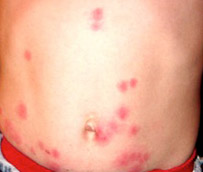 Bed Bug Symptoms and Rash From An Allergic Reaction to Bites on Chest
The appearance of Bed bug bites are allergic reactions. Since it is an allergy to the bedbug's saliva, the skin reaction varies from person to person. Some people can be bitten and not have any skin reaction. Those that are allergic see some form of mild reaction such as small raised red bumps.
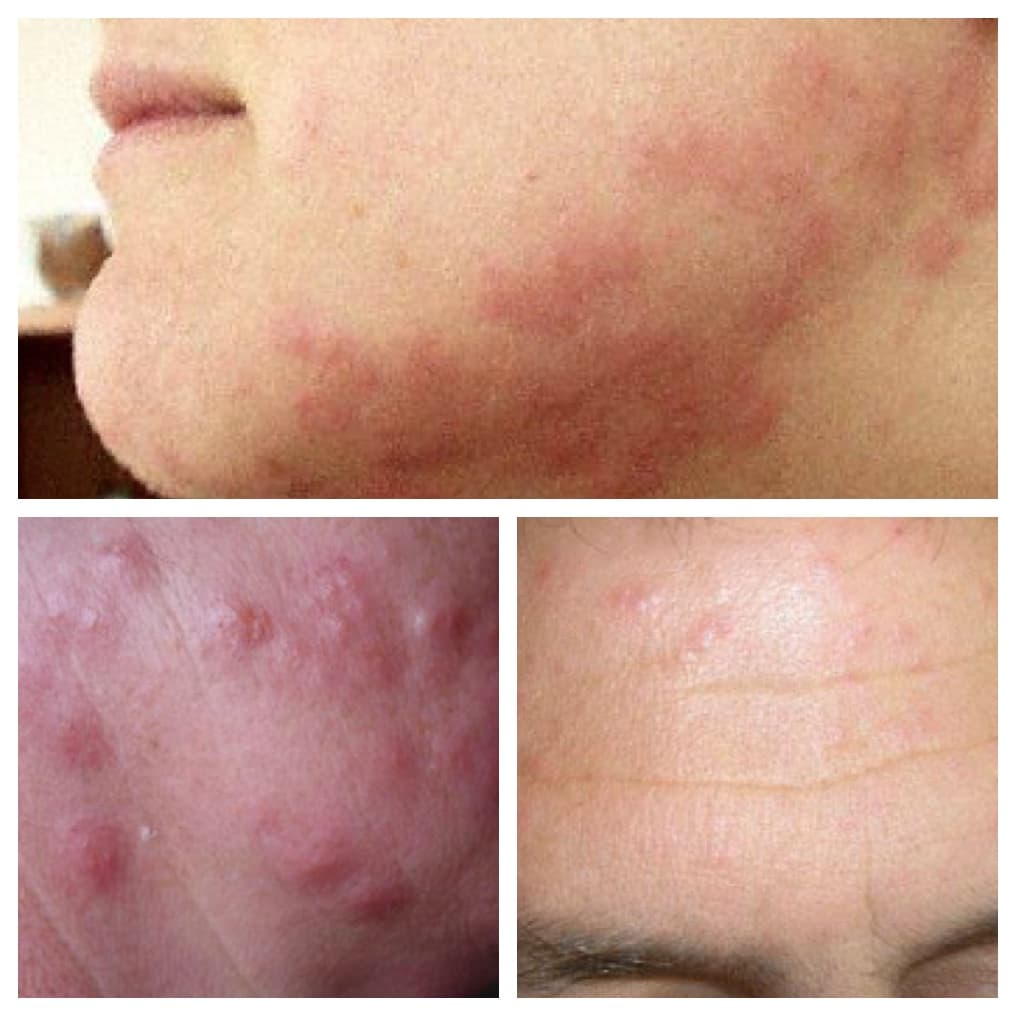 Bed Bug Bites on Neck and Forehead
Typical Skin Reactions in Allergic Individuals:
- Swelling
- Welts
- Severe Itch
Skin reactions can take 14 days to appear.
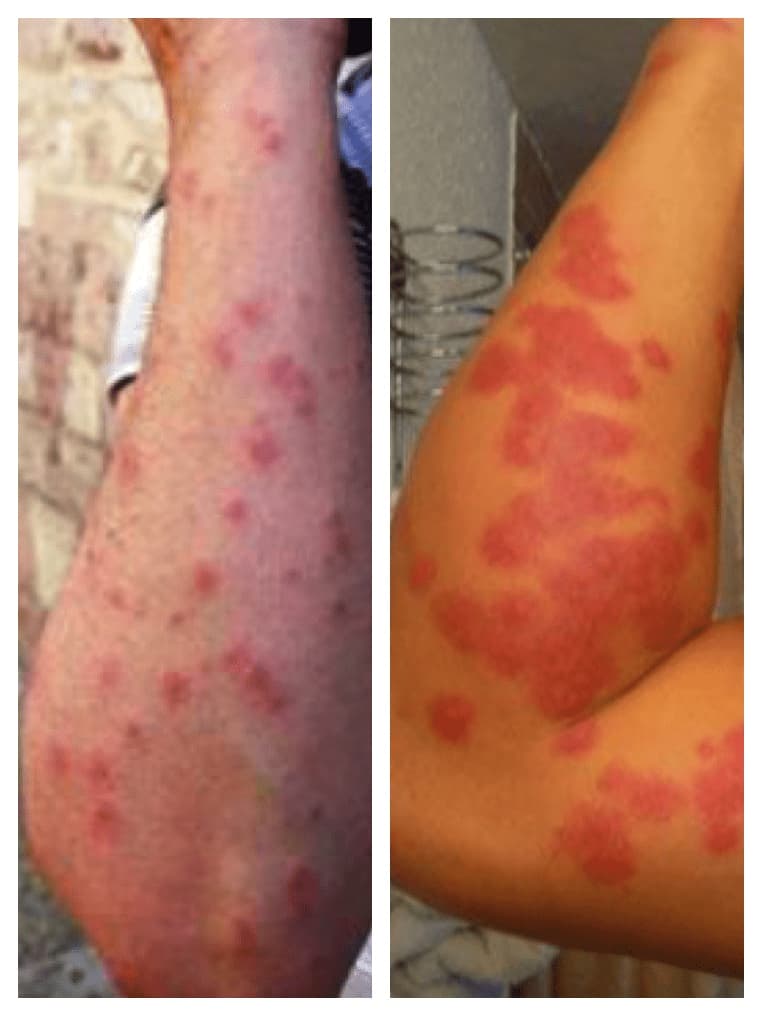 Bed Bug Bite Rashes on Arms in a Line Pattern (Left) and Large Wheals (Right)
There are usually multiple bites in the same area, but a single bite is possible. Bumps are larger than a mosquito bite. Bigger skin reactions or hypersensitivity to the bite can result in the formation of blisters. Bites do not normally require any treatment and will go away on their own in a few days. Bites can be itchy, with any over the counter treatment for itch due to insect bites providing some relief.
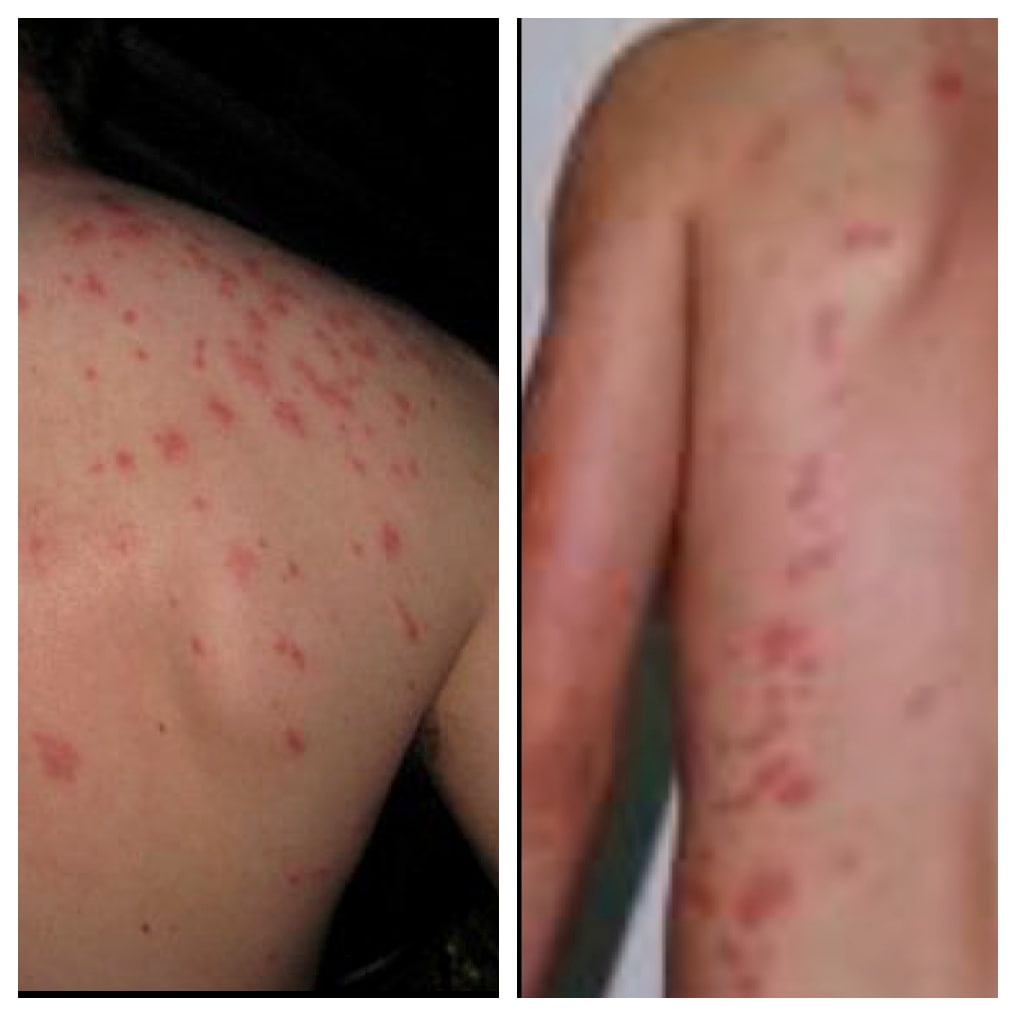 Photos of Bed Bug Bites on Shoulder (Left) and Back (Right)
Bed bug bits are difficult to confirm since they look like bites from other insects. BITES ALONE CANNOT CONFIRM THE PRESENCE OF BED BUGS. YOU MUST LOOK FOR OTHER SIGNS.
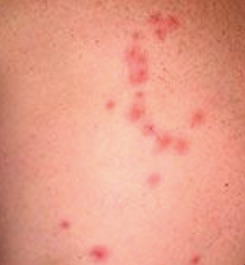 A Bed Bug Skin Bite Pattern Can Consist of One Bite or Multiple Bites in a Circular Shape, Grouping, or Single Row of Bedbug Bites on a Person's Back
Bites are itchy. Scratching can be a source of skin infection since the nails can introduce bacteria into the skin. Smaller bites are hard to distinguish from reactions to to bites from mosquitoes. Bites and itching that is isolated to the lower legs tends to be due to fleas. Bites also need to be differentiated from scabies.
In general, bed bugs do not bite under clothes or on the bottoms of the feet. (tip: if you are concerned about bed bugs wear socks over the bottom of your pajamas to avoid bites on the legs.)
Physical and mental health effects
The most common mental health and physical effects are:
- Emotional stress
- Anxiety
- Agitation
- Sleeplessness
There is NO evidence that bed bugs transmit disease to humans. Over 20 pathogens have been found in the Bed Bug gut with the Mayo Clinic reporting that bedbugs can contain several diseases that are blood borne.
Identification
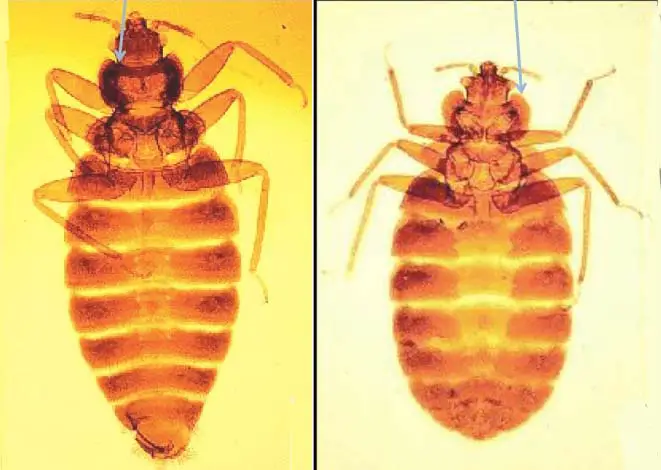 Adult Tropical Bed Bug (Left) and Typical U.S. Bed Bug (Right - Also called Cimex Lectularius). Note Moderately Excavated Area on Tropical and Deeply Excavated Area on U.S.
Adult bugs are about a quarter of an inch long. Young insects are called nymphs, of which there are 5 stages in the bed bug life cycle followed by a 6th adult stage. A nymph is approximately 1/32 of an inch or 1 mm long. An egg is approximately 1 mm long.
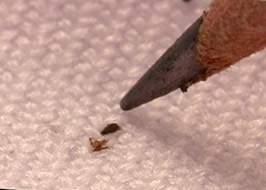 Bed Bugs Grow to 3/16" in Length. Typical size is 1/8" to 1/4". Actual Size Shown.
Bedbugs are small insects that are technically not wingless, although they do not fly and can be seen by the naked eye. They hide in narrow crevices near the feeding area, such as a mattress seam, bed frame, and other furniture, although they can be found in any room or area of a home.
There area many different kinds of bedbugs. One type in
particular likes to
feed on the blood of people, but they will also feed on warm blooded animals and pets such as dogs.
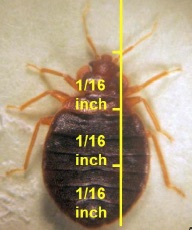 Adult Bed Bug Body Segments
Anatomy Breakdown
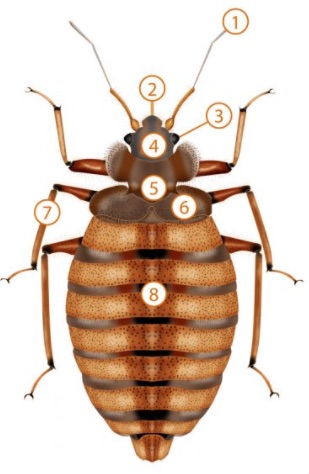 Diagram of Bed Bug Anatomy - See Below For Descriptions
Source: Pronto Pest Management
- Antennae: The antennae are used to guide the insect to a host. Each antennae is divided into four parts or segments. The antennae are approximately 50% of he size of the bedbug's bodies.
- Proboscis: The proboscis is the tube that extends from the bed bugs head. There are two tubes, with one to inject saliva into the host with anti-coagulating properties, making it easier to drink the blood meal without disturbing the human or other host. Each bit enables the bed bug to consumer .0055 millimeters of blood.
- Eyes: Eyes are comprised of segments referred to as ommatidia. These repeating segments or compound eyes are sensitive to any movements. This is how bed bugs know to stay in their hiding spots when there is a risk to their lives.
- Head: the head is broad and short. It is attached to the thorax.
- Thorax: the thorax is where the legs are attached to the insects body. The thorax also connects the head and makes it possible for movement.
- Wing Pads: Wings are vestigial, which means they have undeveloped wings that do not enable them to fly.
- Legs: Bed bugs have six legs. The pest can move 4 ft in about one minute. At the tip of each leg is a claw to grip surfaces, help them climb, and hold onto the host when feeding. They do not have suction pads, making it difficult to move on smoother surfaces.
- Abdomen: The abdomen has eleven segments. When the bedbug feeds segments expand for blood storage, changing the color of the abdomen to a red color. A pointed abdomen indicates that the insect is male, while round tips indicate that the insect is female.
Bed Bugs Color
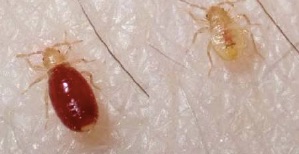 Immature (nymphs) Bed Bugs are Transparent in Color Before Feeding and Light Red After Feeding
Immature bed bugs are almost completely transparent when unfed. After feeding they turn light red and are about the size of an apple seed.
Mature pests are different shades and brown, unfed and fed.
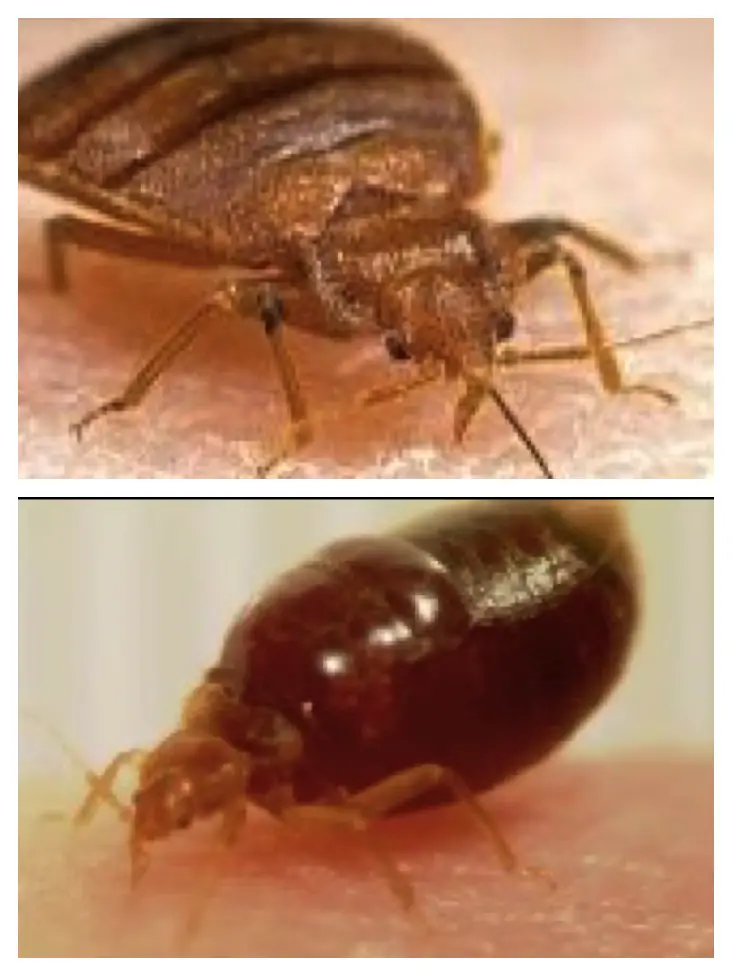 Bed Bugs Are Flat Before Eating and a Swollen Reddish-Brown After Feeding
Bed bugs can be easily confused with other insects such as carpet beetles, bat bugs, or small roaches. We suggest that you try and capture an insect for inspection. You can send an insect to Cornell University for identification.
Life cycle
Bed bugs are hatched from an egg and then move through five nymphal stages (each stage is referred to as an instar.) The insect must feed, and then molt their skins as they move from stage to stage (after each meal). Most nymphs will develop to the next instar within 5 days of a blood meal. At lower temperatures (50° F to 60° F) an instar takes longer to molt.
There are 5 molts before they reach adulthood or maturity. It takes 4 to 7 weeks from hatching to adult. The rate of growth is based on the environment. At temperatures greater than 72° F the process from egg to adult can take in about 37 days.
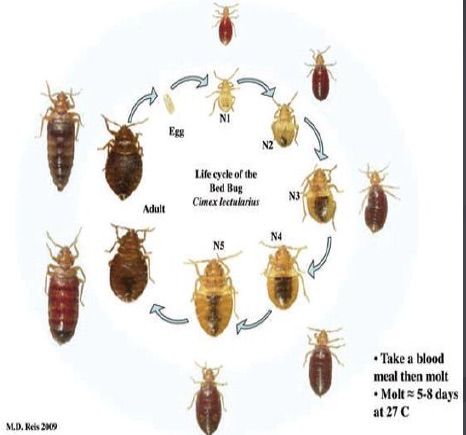 Bed Bugs Move Through 5 Life Stages to Reach Adulthood. Typically Occurs Over 4 to 7 Weeks Depending on Environmental Conditions
The average lifetime of a bed bug is 6 to 12 months under laboratory conditions. Even when conditions are good, some nymphs will not survive and make it to adulthood. For example, if the egg is too far from a host, a nymph may die of dehydration before reaching the host.
Bed Bug Egg Facts
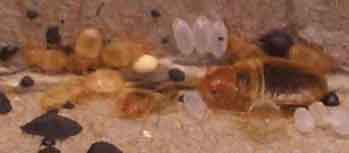 Bed Bug Eggs, Nymphs (baby bed bugs) and an Adult
- 1mm in length
- Laid by female in batches of between 1 to 7 per day, at an interval of every 6 to 17 days.
- A female will produce from 5 to 20 eggs after a single blood meal
- There is a 1:1 ratio between males and females eggs
- One female can lay about 113 eggs during a lifetime
- Eggs have a substance which enable them to stick to surfaces, which is why they can't be simply vacuumed up. You can lift eggs off a surface with duct tape.
- 60% of eggs will hatch at 6 days old at a room temperature greater than 70° F. 90% will hatch by day 9. Under good conditions, 80% of eggs will survive to become adult.
- Eggs will hatch faster by a few days if the room temperature is lowered to 50° F.
- The bed bug population will double every 16 days under ideal conditions which are room temperatures greater than 70° F but less than 90° F.
- Eggs are laid in singles or groups.
- 97% of eggs hatch successfully.
- Females live about one year.
Source for Above: Virginia Tech Department of Entomology
Lifespan
The length of time a bed bug can live is dependent on temperature and how recently they fed. Cooler temperatures result in a longer lifespan. It is possible at the right temperature and feeding schedule, that a bed bug could live for 1 year without feeding again.
Most well-fed bed bugs will live between 99 and 300 days in a laboratory environment (source: VirginiaTech School of Entomology).
Breeding
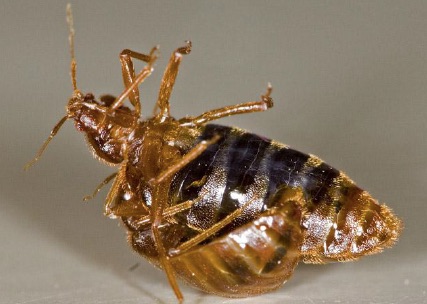 Bed Bugs mate and inseminate a female by piercing the female through the abdomen and inseminate directly into the body cavity.
Bed bugs breed by traumatic insemination. After mating, females are ready to lay eggs.
One pregnant female can result in an infestation of 31,700 insects by June of the same year!
Habits
Bed bugs are unable to burrow into the skin, fly or jump. They move by crawling up to about 20 feet from where they are dropped. Adults can crawl up to 4 feet per minute.
The insects hide in crevices and groups, often in groups. they prefer to hide in wood, fabric and paper surfaces.
Bed bugs feed on blood, usually at night 1 to 2 hours before sunrise during sleep. They will feed during the day if they can.
Feeding
Bed bugs are attracted by heat and CO2. The insect will penetrate the skin with two hollow stylets or tubes. One tube injects saliva. The other tube withdraws blood. They will feed for 5 to 15 minutes and then return to a hiding place.
Room inspection
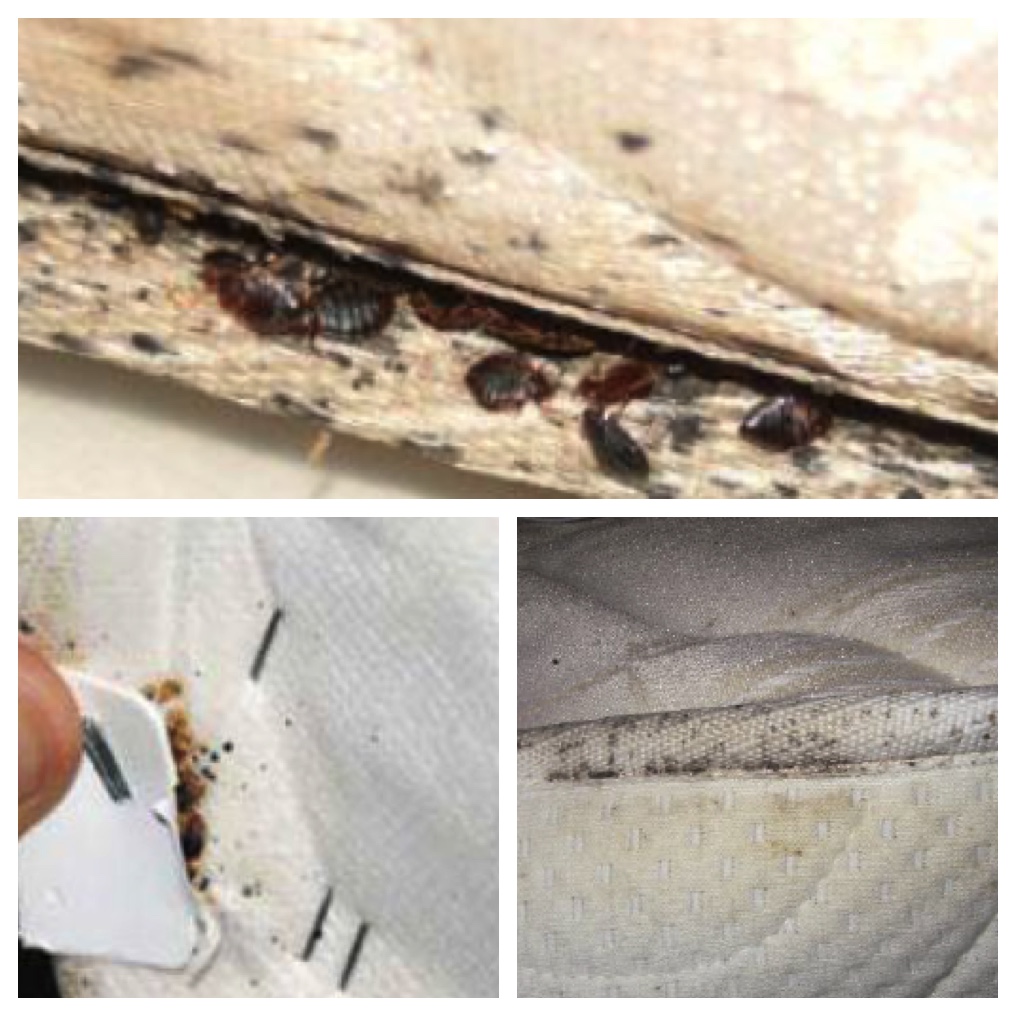 Signs of a BedBug Infestation include BedBug Excrement on Any Mattresses, Molted Skin, and Blood Marks
Bed bugs are good at avoiding detection and try and hide in out of the way, dark and narrow crevices.
Bed bugs are likely to hide where they can feed, which is typically the bed room. Inspect areas closest to the bed first such as bedding, mattress, box springs and headboards. Look for signs such as actual insects, molted skin, or black, brown and red blood stains. Be sure to check mattress seams and infestations that might hide around room clutter.
bed bug typical hiding places
Typical hiding places:
- Dark protected crevices including along the edges of baseboards, floors and carpets
- Door frames and window frames
- Paper, wood and fabric surfaces (they have trouble gripping smooth surfaces)
- Bed frames, box springs, mattresses. Check around any labels and plastic corner guards, and beds.
- Switch plates and outlets
- Torn wallpaper
- Drapes or curtains
- Furniture joints and around the bottoms of any seats. Remove and check drawers, particularly the tracks.
- Inspect fabric on any couches and cushions
- Check clutter clothes near the bed such as shoes or slippers
Bed bugs can be seen with the naked eye. Tiny first stage nymphs in particular will be easier to spot with a flashlight and magnifying glass. Use a credit card to reach into mattress seams to dislodge any hiding insects.
Capture any insect samples in a jar that has a lid that screws or snaps on.
A typical room takes 1 to 2 hours to inspect. In a bedroom studies show that 70% will be near the bed and adjacent night tables.
Treatment
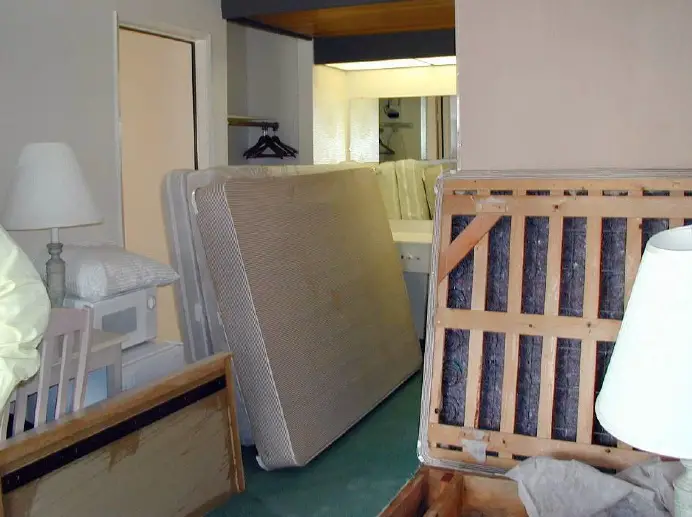 Remove And Dispose of Any Room Clutter and Move Treated Furniture and Objects Into a "Safe" Spaces That Are Outside the Treatment Area or Bedroom"
 The key to controlling a bed bug problem is to act fast and with vigilance.
- If you are a tenant, notify your buildings' management company in writing with the date and time in the letter. Check with your local health department for the rules regarding how quickly they need to respond and who is responsible for payment. DO NOT arrange for extermination without permission as this might violate your lease. If the building is not responsive check to see if other tenants have similar problems and then organize as a group.
- If you are a homeowner, quickly schedule a free inspection using this online form. We also suggest calling elocal at 877-673-2704 or contact a local well known reputable pest control professional. If you hire a pest control company get a guarantee since bed bugs often require two to three treatments.
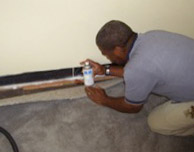 Applying Spray to Wall Cracks and Along the Edge of Floors
Getting rid of the insects can be quite a chore. Removing an infestation involves washing all clothes, bed sheets and linens, treating mattresses and cracks and vacuuming all areas of the room. See our guide for specific steps on how to kill bedbugs. However, we always recommend that you use a professional since it is very difficult for a homeowner to eliminate a bed bug infestation.
Before treatment, ask the exterminator or building management for steps for preparing a room for treatment.
If you do want to try it yourself, such as when an infestation is first starting, there are a number of commercial products that work quite well. Look for a pesticide that states it is safe for humans and pets, and follow the directions carefully. Also make sure it is mattress safe.
Buying a kit can be the most cost effective way to treat a room since all kits have the minimum of three products you will need (contact spray, residual spray, fine powder). After treatment mattresses and the box spring should be sealed in a zippered cover to trap any insects and the harder to find eggs that you may have missed.
If you can afford it, hire a professional (see our list for suggestions.) It can take even the most experienced exterminator up to three treatments. Be sure to ask for a guarantee before agreeing to any service plan. You can also get a free quote from a national exterminator network such as Home Advisor or to speak with a bed bug expert in your area call 877-673-2704.
bed bug Sniffing dogs
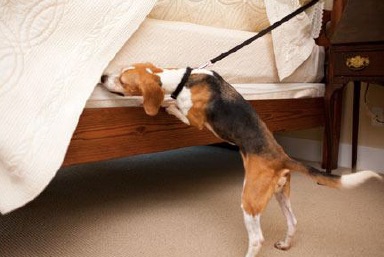 Bed Bug Detection Dogs are Very Effective at Finding Hidden Infestations
Trained dogs are highly effective at sniffing the unique odor omitted by bed bugs. They are particularly good at identifying where the infestations are located, such as inside walls or mattress seams.
elimination and control
Treatment starts with a thorough cleaning. Assume every object in an infested room has a bed bed or egg. Methodically inspect, bag or place in sealed containers, and then remove each item from the room. Do not use boxes. The vacuum is very effective at trapping live insects, but not eggs. Eggs are "glued" to the surface where they are laid. Do not use brush attachments in case any insects hide in the brush after treatment.
Strip the bed, bag and wash all linen and blankets in hot water followed by 20 minutes in the dryer on high heat. Place pillows directly into the dryer (only carry through home after they have been bagged). Next, after you treat the mattress, move it out of the treatment area. Do the same with the box spring, moveable furniture, lamps etc. until the entire room is treated.
You do not have to throw out the mattress or box spring. Instead treat and then use a bed bug proof cover to trap any insects you might have missed. Bed bugs will starve and die if trapped.
Repair crevices and cracks in the treatment area to avoid bed bugs that spread into the walls or that want to move into other rooms.
Read more about our step by step instructions for treating bed bugs.
Non-chemical Treatments
- Vacuum
- Stream (very effective, beware of mold unless moisture can dry)
- Mattress encasements
- Traps
- Mechanical Drying
- Heat Treatment Remediation (professional only)
- Freezing Spray (professional only)
Chemical Treatments
- Sprays (Contact Mattress Safe Spray and Residual Spray)
- Dust (only with face mask and applicator)
- Fumigation (professionals only)
Purchase in a kit or hire a professional. Carefully follow manufacturers directions for application and use around children and pets.
Do not use bed bug bombs. These products just chase the bed bugs into the walls and are ineffective. A limited number of natural sprays have been tested and are effective such as Bed Bug Patrol. That said. insecticide based sprays are more effective. Test sprays on an out of the way spot to determine if they will stain any furniture or carpet.
Before purchasing any insecticide check to see if it has been tested on bedbugs that have shown insecticide resistance. All products offered by Bed Bug Supply have met this requirement.
If you dispose of any items clearly mark them as having bed bugs. Some jurisdictions require that any mattress set outside for disposal must be placed into a bed bug casing.
After treatment
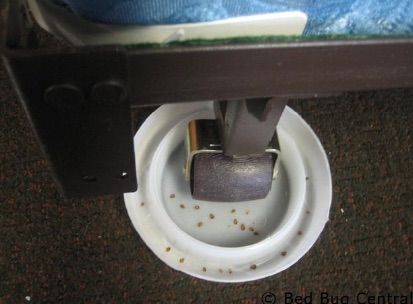 A Bed Bug Trap Is a Good Test To Determine if a Bed Bug Infestation Has Been Eliminated or Reduced in Side. A Clean Trap For Two Weeks is a Good Sign That The Problem Has Been Eliminated From Bedrooms or Other Spaces.
Shown: Climbup Bed Bug Trap
After treatment, use a bed bug trap to determine if there are no more insects in the room. Purchase either a CO 2 trap or glue trap that attracts the insects, or place inexpensive trays designed for this purpose (called Climbup) under each bed leg. Each tray has a well where bed bugs become trapped.
Prevention
To prevent bed bugs learn how to recognize the sizes.
- Check the mattress for black fecal marks, blood stains and spots, molted skins , eggshells, or actual bed bugs. Double check an mattress seams and loosen any insects using the edge of a credit card or brush.
- Do not enter hotel rooms with your luggage until you inspect the bed. No stains probably equals no bed bugs.
- Take precautions when traveling. Keep clothes in zippered luggage. Hang clothes in the shower. Inspect any backpacks or luggage before turning home.
- Smell the room for a sweet or musty odor, a sign of severe infestations.
- Keep rooms clutter free providing fewer places to hide. Inspect all objects such as books.
- Seal any cracks and crevices to avoid spread from adjacent rooms or apartments.
- Keep objects away from walls. Note that bed bugs can drop down from ceilings.