table of contents
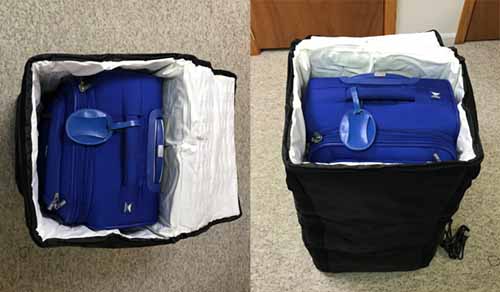 One Way To Avoid Bringing Home Bed Bugs From Cruise Ships and Hotels Is To Purchase A Home Heat Chamber Which Kills Any Insects Before You Unpack
Shown: ThermalStrike Heat Chamber
do cruise ships have bed bugs?
Bed bugs are just as likely to occur on a cruise ship as they are in a hotel or motel. Bed bugs are most commonly found in homes and apartments followed by hotels and motels. (1)
Any type of hotel or ship can suffer from bedbugs
including premium or 4 star hotels. The reason is that
the presence of bed bugs has nothing to do with cleanliness.
The only way for a bed bug to get on a cruise ship is to be carried onto the ship by a passenger. Often that happens after that a person stays in a bed bug infested hotel the night before the cruise. The bedbugs hide in the luggage and then hop off at their next destination.
Once on the ship they can multiply and spread rapidly. Because of this, no home, apartment, hotel, airplane or ship anywhere in the world can protect itself. The best approach is to know what to look for and how to travel bed bug free.
bed bug cruise ship reports
No cruise line or hotel is immune from bed bugs since they are carried on by travelers. Any online search will find reports such as the following:
- Norwegian Pearl (9/2015)
- Norwegian Sky (3/2017)
- Norwegian Breakaway (5/2016)
- Island Princess (12/2002)
- Royal Caribbean (2/2017)
- Disney Dream (7/2016)
- Celebrity Silhouette (2/2012)
All cruise lines now have written treatment plans such as this one from Carnival. To avoid bringing home bed bugs we suggest 1) asking the steward assigned to your room about any infestations and recent treatment and 2) do a room inspection as soon as you arrive (see below for tips).
How to Avoid A Bed Bugs Cruise Ships Problem:
Here's our Checklist on to avoid bed bugs cruise problems when starting a cruise:
- Use Hard or Bed Bug Proof Luggage: Bed bugs avoid hard surfaces. Vinyl and fabric luggage provide multiple hiding places such as seams and pockets where bedbugs can hide. Bed Bug Proof Luggage has a built in heating element which can kill bed bugs before you return home.
- Inspect the
Room: Check the mattress seams and around the edges of the headboard for brown fecal
spots or reddish spots.
- Ask the Room Attendant: Find out if there has been a problem on the ship and make sure it was at least 100 feet from where you are staying.
- Consider
Using a Bed Bug Interceptor: These are small bowels you
can place under each bed leg when avoiding a bed bugs cruise
experience. Any bedbugs that climb up the
bowl, will be trapped inside. This is also a helpful way to
determine if the room has bedbugs.
If you wake up and trap any, call the attendant. No bugs, you are home free, enjoy the cruise. You can get a 4 pack of ClimbUp bowels from Amazon. - Move the Bed: Keep the bed at least 6 inches from the wall and other furniture.
- Keep Luggage on Racks and Off The Floor: When opening your luggage, keep it on a rack, that is at least 10 feet away from the bed, and 6 inches from a wall. This will minimize the chance of bed bugs hopping from the furniture or wall to your luggage.
- Keep Luggage Zipped: Keep your luggage zipped and your clothes in the luggage. Bed bugs cruise problems often spread to room furniture. If you keep your luggage zipped it gives bed bugs fewer places to hide. Keep clothes out of closets.
- Hang clothes on the shower bar: Bed bugs tend to avoid smooth hard surfaces. Also, keeping clothes away from the walls will to avoid any bugs hiding in the clothes.
- Pack Machine Washable Clothes: When you return home, open suitcase (after inspecting outer seams for bed bugs) at washing machine. Wash clothes in hot water followed by 20 to 30 minutes in the dryer.
- Look for Bites: Bed bug bites are the easiest way to tell if a room has a bed bug problem.
How to Inspect The cruise cabin for bedbugs
- Inspect the bed - a clean mattress around the seams is a bed bug free mattress.
- Inspect the headboard - Bed bugs hide in credit card thin spaces.
To avoid bedbugs, be sure to inspect the cabin prior to bringing your luggage into the room. The easiest was to do this is to check the mattress, as studies show that 50% of the bed bugs in a room will be in around the bed. You can also ask your room attendant if the ship has had any problems and how they were treated. Many ships will super heat a room for several hours at 120 degrees to kill all bed bugs. This is a very effective method.
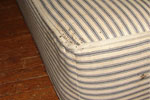 Always Do a Bed Bugs Cruise Mattress Mattress Check. If you see actual insects, skin that has molted off, or an actual insect in the seams, report the problem immediately.
Bed bugs leave behind brown fecal spots on a mattress, usually near the seams or other hiding spaces. They also molt and may leave behind shells. If you see brownish or reddish spots, what looks like the skin of a bug, or any other discoloring, DO NOT bring your luggage into the room. Ask to speak to someone in charge of the rooms. Cruise ship personnel have been trained to spot bed bugs.
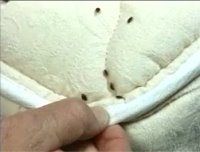 Picture of Bed Bug Fecal Stains
If yoU suspect That there are bed bugs:
If you suspect the presence of bed bugs, ask for another room that is at least 100 feet away from the room you are giving up. 100 feet is the approximate distance a bed bug will walk from room to room looking for a human host.
Beside the bed, check the headboard and if there are any bed seams. The picture below shows common bed bug hiding places:
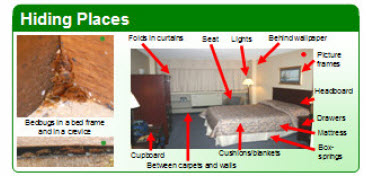 Picture of Bed Bugs Cruise Hiding Places
Can Bed Bug Sprays Help You Avoid Bed Bugs Cruise Ship Problems?
There are several spray on the market that claim that they can repel bed bugs. We recommend the Bed Bug Patrol Luggage spray because the manufacturer went through the trouble of providing treatment test from Snell Scientific. The spray demonstrated a 100% mortality rate on the tested bed bugs.
The spray is made with essential oils and is 100% natural, so you do not have to spray an insecticide on your luggage or bed.
How to Avoid Bringing Bed Bugs Home From a cruise
- Wash The Clothes: When you get home, open suit cases at the washing machine. Inspect all luggage seams for bed bugs. Washing on the hottest setting followed by 20 to 30 minutes in the dryer kill all bed bugs and eggs. What you can't machine wash, bring to the dry cleaner.
- Buy a ThermalStrike: A ThermalStrike is a portable home heat chamber for the home that can super heat your luggage to the level needed to kill bed bugs and other insects. Simply insert your luggage into the Thermalstrike, turn it on, and remove your luggage several hours later, bed bug free.
- Keep Luggage in the Car or Garage After You Return Home: Extreme heat and cold will kill bed bugs. If you live in a warm climate, keep your suitcases in the trunk for a day. If temperatures in the car reach 120 degrees, it will kill most of the bed bugs. The same goes for 3 to 4 days of freezing temperatures.
What doesn't work?
Fabric sleep sleeves that you bring with and sleep inside, probably will not protect you from bed bugs as they can bite right through the fabric. Mattress Covers that are bed bug approved will trap any bugs that are hiding in the mattress and keep them from biting, but if this problem exists in a room, there are probably bugs outside of the mattress that will bite you anyway, but it could help cut down the chances.
What do Bed Bugs Look Like?
Bed bugs take on a different appearance depending on where they are in their life cycle. As you can see below, they start as small white eggs which are cemented onto the surface. Eggs are visible to the eye and are the size of a pin head. A bed bug nymph is small and straw colored and are approximately 1/8 inch. An adult will grow to 1/4 inch and will take on a darker reddish brown color. Bed bugs also give off a distinct raspberry like odor, which is why bed bug sniffing dogs are often used to spot an infestation.
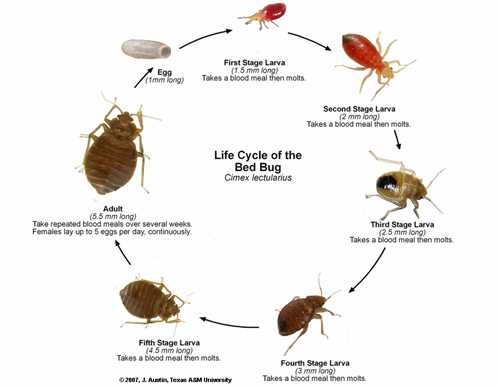 Bed Bugs Pictures at Each Phase of Lifecycle
How to Recognize Bed Bug Bites?
The familiar red skin bumps associated with bed bug bites is actually an allergic reaction. Most people have no reaction. Others either develop a cluster of 3 red bumps.
A bed bug bite is actually a skin puncture from two rods
that jut out from the head of the bedbug. The bite has a clear center
with two small puncture marks. Bed bugs only bite at night
and feed for approximately 5 to 10 minutes. A reaction can
appear as early as an hour later or even several days later.
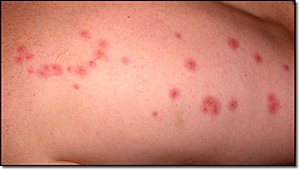 Pictures of Bed Bug Bites
Beyond the red bumps, the most prevalent symptom is itch. Most bites will heal by themselves in 3 to 5 days. You can buy an over the counter itch cream or one made for bed bug bites such as All Stop. If you scratch the bites, they can become infected, and will require an antibiotic ointment or trip to the Doctor for oral antibiotics.
An allergic reaction to bed bug bites can worsen with each bed bugs cruise episode as your body becomes more hypersensitive to the proteins left behind by the bedbugs. Bite reactions tend to appear on exposed areas of the body including the legs, arms and neck. While possible, bites rarely appear on the bottoms of the feed, fingers and face. If bites are isolated to the bottoms of the feed, the problem is more likely to be scabies, which is caused by mites.
If one person experiences bed bug bites on a cruise and another in the same bed does not, it means that either the person without bites was bitten, but didn't have an allergic reaction, or the bed bugs are only hiding on one side of the bed. The bugs tend to cluster in small groups and hide in the seams of the mattress.
Submit a Bed Bug Report
Help others by letting us know about any bed bug reports.
brochure
Free handbook for how to avoid bed bugs on a cruise ship, hotels or when traveling.
references
(1) American Entomologist, June 2017